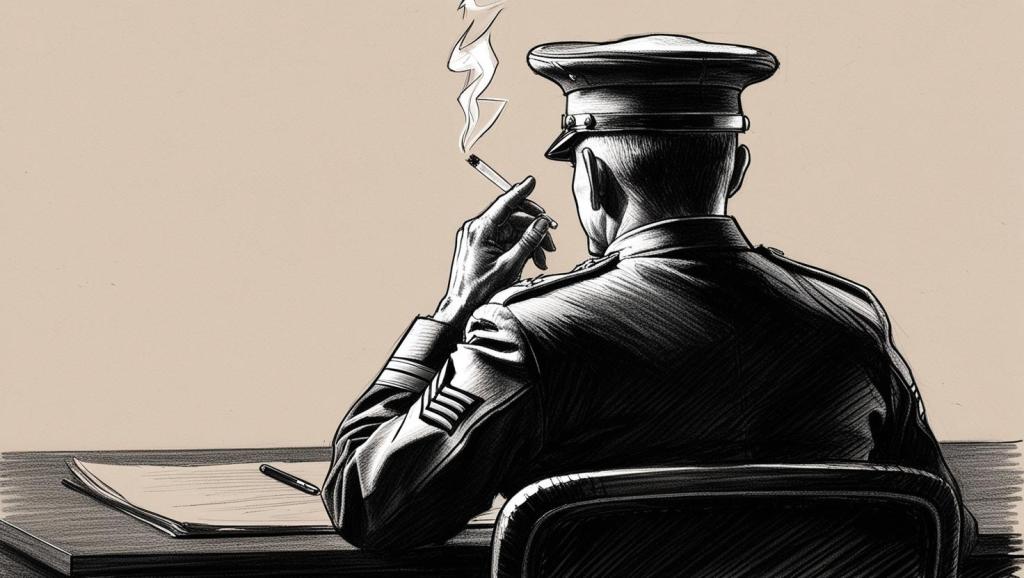
Another Capstan cigarette burned in Lê Quang Ninh’s hand. Normally, Ninh didn’t smoke much. But this morning, after working with the company commanders, alone in his room with an empty coffee cup, this large-framed, seemingly very imposing battalion commander had taken to smoking as his “ally” in deep thought. “So, it’s been seven years since the day Ms. Tư Nhẫn came to the Lương Hòa post to give me the mission that I haven’t had the chance to carry out to ‘break free.’ And it’s been twelve years since Mr. Mười Hòa admitted me to the Party and sent me to infiltrate the Thủ Đức military officer training school (of the enemy). Twelve years of living a double life, ‘green on the outside, red on the inside.’ Exposing my name and face but having to ‘hide my tracks,’ playing the role of a talented and cunning person, from a trainee to now having climbed to the rank of major, commanding an elite main-force battalion of the enemy. But with twelve years of hiding in that position, what will I do before the situation of the entire South is like a surging tide, our large army wings are closing in on Sài Gòn, so that all the efforts of the organization and myself won’t be in vain at this moment?…”.
Ninh finished his third Capstan cigarette but still couldn’t end that train of thought. He was trusted by the enemy general Lý Tòng Bá, commander of the 25th Division, to command the 1st Battalion, 50th Regiment, a spearhead battalion of the entire regiment and division. Ninh’s battalion had just been separated from the regiment’s formation from Tây Ninh to become the division’s reserve force, strengthening the defense of the Đồng Dù base in Củ Chi, a crucial “fortress” guarding the northwestern gateway of Sài Gòn. With his military knowledge combined with the organization’s nurturing through secret channels, when he saw Nguyễn Văn Thiệu lose Tây Nguyên and then Nha Trang, Đà Nẵng, and the entire Central region fall into the hands of the liberation army, Ninh was very happy, believing that from this strategic failure of Thiệu, the day of total victory for the revolution was near. Joyful and secretly pleased, but as the sound of our great army’s guns grew closer to Sài Gòn each day, Ninh’s heart burned like fire. Ms. Tư Nhẫn, after being imprisoned by the enemy for more than a year, upon her release, continued to contact and directly guide Ninh on behalf of the region’s Military Affairs Committee. From this reunion, she also involved Ninh’s wife in the mission. Moreover, thanks to his influential “godmother’s” support, Ninh had his own house in the family area of high-ranking officials of the Sài Gòn government in Long An, and with the rank of major commanding a battalion in the enemy’s “darling” division, 25th Infantry, Ninh’s “cover” became even more solid, making the contact between Ninh and Ms. Tư even safer and more convenient. Through her, right from the time we liberated Tây Nguyên, Ninh had received instructions from above: “Still lie low.” Only skillfully shake the fighting will of the officers and soldiers under his command, ready to receive specific tasks…”.
Ninh understood the deep meaning of the word “skillfully.” It meant that, like in many years past, especially in recent years when he had greater position and prestige, Ninh had to be extremely cunning and intelligent, taking advantage of loopholes in the enemy’s regulations to secretly sabotage and “blindfold” them while still consolidating and enhancing his prestige with both his superiors and subordinates. He had to win people’s hearts, secretly persuade the entire battalion to follow his plans, such as the case of the American advisor counting Việt Cộng corpses at the end of 1971.
At that time, in Ninh’s 25th Division, the scoring for evaluating battalions and regiments was specified by two criteria: The unit with the fewest casualties and losses. The unit that killed the most Việt Cộng. The Việt Cộng killing criterion was further calculated as: One personal gun captured was counted as two Việt Cộng killed. One communal gun captured was counted as four Việt Cộng killed. And each month, company-level units had to eliminate five Việt Cộng from the battlefield.
According to those criteria, when the units reported to the division, the American advisors at the division found the number of Việt Cộng killed very suspicious. They asked the division command representatives and the American advisors to pay attention to counting Việt Cộng corpses when inspecting operations by helicopter. They tested this corpse-counting in operations, and Ninh’s battalion participated in this very practical “game” of the Americans.
In the battalion inspected earlier, the division’s deputy commander turned red with embarrassment before the two American advisors because the helicopter searched repeatedly in the battalion’s operational area but only suspected a few Việt Cộng corpses, a far cry from the report.
Ninh grasped this information. Once, during an operation in the Dương Minh Châu area, he called the company commanders to give instructions:
“Comrades! In this operation, our 1st Battalion has been fighting here for three days. The officers and soldiers in the battalion are tired and want to be relieved back to the barracks. Staying here, the mop-up operation against these unknown enemy forces, we can hardly avoid increasing the number of soldier casualties. But to be relieved, we must have at least 20 or more Việt Cộng corpses in our operational area. That number is not only recognized by the battalion commander’s report to the higher-ups. This time and this afternoon, the American advisor of the division and Brigadier General Lê Văn Tư will inspect the battlefield and count Việt Cộng corpses from a helicopter. If we have enough of that number plus the number of weapons captured to calculate the number of Việt Cộng killed, not only will all officers and soldiers of the battalion be commended but we will also be relieved soon back to the barracks for rest. So, company commanders, please report clearly how many Việt Cộng corpses are in your unit’s area, and how many weapons have been captured?”
After hearing Ninh speak and ask, all the company commanders were silent, only glancing at each other and then looking down. The company commander of Company 1, who was usually quick-tongued in every meeting, only answered by gesturing with his hand to shield the flame of his cigarette lighter.
Seeing this, Ninh put on a cheerful face and urged:
“Come on, comrades, report. And,” he looked straight at Captain Vang, the company commander of Company 3, encouraging him because he seemed like he wanted to speak: “Captain Vang, please report first!”
“Sir!” Encouraged, Vang boldly said, “These American advisors’ setting up this Việt Cộng corpse-counting is very difficult for us to find an ‘answer’ to. They pay the Republic of Vietnam’s army, so they come up with many things to check. In reality, how many Việt Cộng have we killed? Those killed by us are sometimes civilians. And, if they were Việt Cộng killed by us a few days ago, their comrades would also find ways to take the bodies away for burial, leaving few corpses behind to count.”
“Captain Vang is right, sir!” All the company commanders almost unanimously agreed with Vang’s statement.
“So, what can we do to deal with this situation so that the higher-ups don’t doubt our achievements in the past few days, and we can end the operation soon?”
Ninh looked at the faces of all the company commanders, but like the previous time, they were all confused and silent. A few minutes later, the company commander of Company 1 raised his hand. That usually quick-tongued officer now spoke up:
“Sir! I know our battalion commander is full of ideas. In this matter, I’m sure ‘big brother’ already has a reasonable plan. I suggest ‘big brother’ just give the order, and we will strictly carry it out.”
“Yes, Captain Vi’s idea is very correct, sir!” Everyone chimed in again.
Ninh pretended to be pensive. Because this chess move was in a checkmated position, it was not easy to find a way to break it. Through this, he also understood more about the psychology of the company commanders. They would agree and keep his solution a secret because, in name, he had democratically discussed it.
“Alright! First of all, you comrades have all agreed that we must have a solution to resolve this checkmate. So, we all have to secretly ‘join hands and get to work, not just give up.’ In my opinion, the forest we are operating in is very large, with many tall trees, no landing pad, and it is easy for aircraft to be shot at from the ground. Even if the helicopters fly low, they can only fly over the tall treetops. Therefore, those American advisors can’t clearly distinguish the faces of each Việt Cộng corpse, only see their shapes like human bodies. With such characteristics, we can completely prove that there are many Việt Cộng corpses in our operational area by deceiving those Americans.
How to deceive them? By having you comrades explain the harms of the American advisors’ ‘counting Việt Cộng corpses’ to the soldiers in your companies. After that, each company will send 5 to 7 soldiers to ‘act.’ They have to take off all their uniforms, only wear shorts or find clothes similar to those of the guerrillas, and completely disguise themselves as dead bodies. Those ‘Việt Cộng’ will lie in various positions scattered under the trees, but from above, the helicopters must be able to see them clearly. The company commanders themselves must ‘direct’ the assignment of which soldiers and where they lie. After this meeting, by noon today, those ‘Việt Cộng corpses’ must be deployed, because the helicopters will be flying over this area from this afternoon, and remember to mark the dead bodies with colored smoke for easy observation.
That is the first task, and this task is the most important at the moment. As for the matter of capturing weapons to calculate the number of Việt Cộng killed, the companies still have the soldiers collect them as our battalion has done in the past few operations.
Regarding this weapon collection, Ninh knew that the American advisors and higher-ranking commanders only needed “trophy” guns regardless of whether they were Russian or American, because the Việt Cộng and guerrillas also used captured American guns. Therefore, Ninh ordered the soldiers in the battalion to collect all kinds of guns that the American soldiers had left on the battlefield or guns that were burned or damaged in fires. After collection, they were all submitted to the battalion and put in the warehouse. With that capital, Ninh’s battalion often scored high in the number of Việt Cộng killed converted from the captured guns…
Ninh also reminded them about the weapon collection at this time, which was also a subtle way of telling the company commanders: “What we are doing here is entirely for the common good of the whole battalion, you must keep your mouths shut…”. When Ninh finished speaking his “diệu kế” (wonderful plan), which was also like an order from above, all the company commanders’ eyes lit up, expressing their admiration for the battalion commander, and they hurriedly left to carry out their duties.
Three hours later, the UH.1 helicopter began to sweep over the combat area of the 1st Battalion. Not long after it disappeared from the sky, Ninh received a commendation telegram from the division commander because the American advisors had counted nearly 20 Việt Cộng corpses killed by Ninh’s battalion. Along with that telegram was a medal for the battalion commander and a bonus for the whole battalion. Even happier for the officers and soldiers of Ninh’s 1st Battalion was the order to withdraw from the combat area to the barracks for rest the next morning because the battalion had completed its mission in the operation.
Ninh smiled inwardly when he received this praise. So, with one arrow in this “battle,” he hit four targets:
- The battalion had concrete achievements before the American advisors, saving face for the division command.
- His unit was relieved and withdrawn from the combat area, avoiding further casualties for our people and the soldiers in his battalion.
- The prestige of the 1st Battalion, and directly his own, was raised higher in the eyes of the higher-ranking commanders and those American advisors.
- His voice in the battalion became more important after this matter. The officers and soldiers in the battalion, out of admiration, would follow his every order, because they clearly saw that all his “diệu kế” were for their lives and interests.
Among the “four targets” hit above, the fourth target was the most important to Ninh. If the higher-ups asked him to mobilize the entire battalion to mutiny and coordinate with the liberation army to occupy a base, or to lead the entire battalion in a mutiny to join the liberation zone, this influential voice with the soldiers of the battalion would be the most essential factor.
(To be continued)
HÀ BÌNH NHƯỠNG
 Agent110: The Flag of Uprising