
Background & Military Career
Lê Quang Ninh was born on November 10, 1942, in Đạo Thạnh commune, Châu Thành district, Mỹ Tho province (now Mỹ Tho City), Tiền Giang province, south of Saigon. He hailed from a prosperous and traditionally Confucian family with a history of patriotic revolutionary involvement. His father, Lê Văn Hổ, a pre-insurrection cadre who opposed the French, had been arrested by them on three occasions. The second-youngest of fifteen siblings, all of whom participated in the anti-French and anti-American revolutionary movements, Lê Quang Ninh was deeply influenced by his family’s activism. Twenty-two years after the Reunification, his mother, Nguyễn Thị Long (deceased), was posthumously honored with the title of Heroic Vietnamese Mother by the Socialist Republic of Vietnam for her significant sacrifices, including having numerous children perish in the wars against the French and Americans, and for dedicating her life to sheltering revolutionary cadres.
Upon graduating with distinction from Nguyễn Đình Chiểu High School (Mỹ Tho) in 1963, Lê Quang Ninh was recruited by Mr. Mười Hòa, Head of the Mỹ Tho Provincial Military Proselytizing Committee, to attend the Reserve Officer course at the Thủ Đức Military Academy. This academy, founded by the French Army and the National Government of Vietnam in South Vietnam, served as a pathway for his planned espionage activities. Subsequent to his graduation from the Thủ Đức officer training, Lê Quang Ninh was commissioned as an officer in the 25th Division of the Republic of Vietnam Military Forces.
Early April 1975, Major Lê Quang Ninh received a confidential directive from the Military Proselytizing Committee of the Southern Central Department: “From April 25th to 28th, initiate a battalion-level mutiny and return to the revolutionary forces.”
Republic of Vietnam Military Forces (RVNMF)
Following his graduation from the Thủ Đức officer training at the end of 1964, Lê Quang Ninh was commissioned as a First Lieutenant and assigned to the 25th Division (also known as Tropic Lightning), a division prioritized by the American-supported government. Utilizing his reputation and military acumen from 1964 to 1975, Lê Quang Ninh earned the confidence of the enemy’s General Lý Tòng Bá, leading to his promotion to Major and command of an elite main-force battalion – the 1st Battalion, 50th Regiment, a spearhead unit of both the regiment and the 25th Division.
The rank of “Major” afforded Lê Quang Ninh significant camouflage within the ARVN. Furthermore, his ownership of a house in the high-security residential area designated for high-ranking Saigon officials in Long An enhanced the security and convenience of his contact with his handler, Ms. Tư (Tư Nhẫn).
Portrait of the Operative Coded Number 110
Following his family’s history of activism, Lê Quang Ninh became secretly engaged in revolutionary activities from a young age, starting with the Mỹ Tho student movement that grew out of the 1959 Đồng Khởi Movement. He formalized his commitment by joining the Communist Party in 1963.
Upon graduating high school with distinction in 1963, his potential was recognized by Mr. Mười Hòa, Head of the Provincial Military Proselytizing Committee, who then recruited him to the Thủ Đức Reserve Officer training program to undertake espionage assignments.
Upon graduating from the Thủ Đức officer course at the close of 1964, the Military Proselytizing Committee assigned him the mission of deep infiltration into enemy military ranks. He subsequently became an officer within the Republic of Vietnam’s (RVN) 25th Division. At this time, the 25th Division had recently relocated its rear base from Quảng Ngãi to Hậu Nghĩa (Đức Hòa) to safeguard the northwestern approaches to Saigon. Consequently, all movements and military intentions of the 25th Division became readily accessible to the Mỹ Tho Military Proselytizing Committee.
Recognizing the strategic importance of his intelligence contributions, the Mỹ Tho Provincial Party Committee transferred him to the Military Proselytizing Committee of the Southern Central Department. From this point forward, he operated under the code 110 (or T5), with his sole point of contact being comrade Tư Nhẫn, his handler, also identified as Nguyễn Thị Nhẫn – a covert liaison officer within the Military Proselytizing Committee of the Southern Central Department.
1975 – Uprising and Fall of Saigon
On April 25, 1975, from two directions, Phước Chỉ (Trảng Bàng) and Trung Hưng (Trung Lập Thượng, Củ Chi), the 3rd Corps formed a pincer movement close to the defense line of the RVN 25th Division. When L.19 reconnaissance aircraft flew over Trảng Bàng, Gò Dầu reported seeing “Việt Cộng soldiers”. General Lý Tòng Bá hurriedly sent mobile rescue forces (1st Battalion/50th and 10th Armored Squadron) to block Lộc Giang.
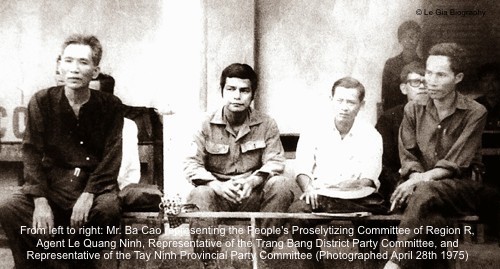
On the morning of April 28, 1975, upon receiving the order to withdraw to Đồng Dù, Major Ninh knew that the time to play his trump card had come. He proposed that his battalion go first to clear the way, and that the tanks of the 10th Armored Squadron would move two hours later. The proposal was accepted. When stopping at Gia Lộc communal house, Gia Huỳnh hamlet (Trảng Bàng). Major Ninh saw this as a favorable location to organize a rebellion. He invited the officers in the battalion command and the four company commanders to a meeting on the spot.
With sincere words, he analyzed the political situation in Saigon: “President Thiệu and Prime Minister Khiêm have fled abroad, the General Staff has no one left. If we continue to fight, who are we fighting for, what is the benefit? In this situation, we must save ourselves. I ask you to join me in breaking away from the RVN army and turning our guns to the Liberation Army.” Everyone was stunted by his words, but no one had any objections. “Major” Ninh introduced himself as a member of the Southern Liberation Front and then read the 7-point policy of the Front. He concluded with the question: “Do you comrades agree to rebel?”. Everyone raised their hands in unison.
Lê Quang Ninh listed the anti-war uprising committee including 6 people, including officers and non-commissioned officers in this committee:
- Deputy Battalion Commander Lam Sơn (aka Bùi Văn Nam Sơn)
- Company Commander Lê Kim Thành
- Company Commander Trương Văn Tuệ
- Sergeant Nguyễn Văn Ngữ
- Sergeant Lê Văn Lữ
Deputy Battalion Captain Bùi Văn Nam Sơn was assigned by Major Lê Quang Ninh to contact the Liberation Army. Captain Nam Sơn and two soldiers wearing wireless transmitters, unarmed, tied hammocks to bamboo trees as signal flags, and drove a Jeep towards the Liberation Army stationed. Bùi Văn Nam Sơn was received by the cadres and soldiers of the 98th Regiment (3rd Corps of the Vietnam People’s Army).
After that, “Major” Ninh, driven on his Jeep, left Gia Lộc communal house for An Thành to meet the 98th Regiment commander, informing him that he was a revolutionary cadre coded 110 with the task of carrying out the uprising and bringing soldiers to the revolution.
Lê Quang Ninh led more than 500 elite troops with full weapons and equipment into the revolutionary base successfully.
Through the wireless transmitter, Lê Quang Ninh called on the RVN units to lay down their weapons and break away from the RVN army. He called Tây Ninh Sub-zone, Hậu Nghĩa Sub-zone, Gò Dầu Sub-district, Trảng Bàng Sub-district; the 10th Armored Squadron, the 46th Regiment, the 49th Regiment, the 50th Regiment of the 25th Division and even contacted the division headquarters, urging them to “save themselves”, lay down their weapons to avoid bloodshed.
Most of the other units of the northwestern defense line (RVN) were already demoralized and became even more panicked when they heard that the mobile rescue force had revolted. The units of the Củ Chi defense line of the RVN gradually disintegrated. The 2nd Battalion of the 50th Regiment retreated to the rubber forest near Củ Chi market and then collapsed. The 10th Armored Squadron of Major Tuấn left Lộc Giang, divided into small groups of three or four vehicles, heading towards Chà Rầy, straight towards Củ Chi and then disbanded. Tây Ninh Sub-zone, Trảng Bàng Sub-district, Gò Dầu Sub-district disintegrated on their own. The 49th Regiment and some Đức Hòa local troops retreated to the defense line of the Capital Special Zone, disintegrating on the An Hạ field.
The rebellion of “Major” Lê Quang Ninh significantly reduced the bloodshed of the Liberation Army on the northwestern defense line of Saigon, helping the 3rd Corps to approach Saigon smoothly.
After completing the task of uprising and rebellion, “Major” Ninh and the 1st/50th Battalion moved to Rạch Bùng Binh to hand over to the Military Proselytizing Committee of the Southern Central Department. Here, on May 7, 1975, the Chairman of the Tây Ninh Provincial Revolutionary People’s Committee held a rally to award the “3rd Class Liberation Medal to the entire 500 righteous soldiers of the “1st/50th Battalion, 25th RVN Division”.
On April 30, 1975, two days following the uprising, the Fall of Saigon occurred, signifying the end of the Vietnam War and its subsequent commemoration as Vietnam’s National Reunification Day.
April 30, 2025, will mark the 50th anniversary of the event, a significant milestone for Vietnam and its people.
After 1975
After the country’s reunification, agent Lê Quang Ninh was transferred to work at the Counter-Intelligence Agency of the Ho Chi Minh City Police Department. Here, he continued to participate in breaking many espionage cases, contributing to protecting the revolutionary achievements.
In the following years, he was transferred to the Ho Chi Minh City Industrial and Commercial Reform Committee, holding the position of Deputy Head. He resolved many complaints to return houses, land and property to families on the “Petty Bourgeois” list.
In 1995, after completing the assigned responsibilities, he decided to retire to build a small production facility to take care of his family.
Subsequent to his retirement, his active engagement with charitable initiatives persisted, encompassing contributions to Hunger Eradication-Poverty Reduction efforts and support for victims of Agent Orange.
In April 2011, Lê Quang Ninh and Nguyễn Thị Nhẫn (Tư Nhẫn) – former staff member of the Military Proselytizing Committee of the Southern Central Department were awarded the title of Hero of the People’s Armed Forces of Vietnam by the State.
On June 20, 2018, He passed away at his private residence in Ho Chi Minh City.
He was 77 years old.
 Agent110: The Flag of Uprising